Showing posts with label Path to the PhD. Show all posts

Saturday, May 3, 2014

"Path to the PhD" Workshop

A warm thank you to all who were able to attend our annual "Path to the PhD" workshop last week, and a very special thank you to Dr. Nate Mills who shared all of his expertise with us about applying to and entering PhD programs.

For those who were unable to attend the workshop, you can find Nate's handout from the workshop here for download.

Thanks to all who continually support AGSE and our events, and we wish you all the best as we approach the end of the semester!

Monday, April 21, 2014

Path to the PhD Workshop

It's almost here! Our annual "Path to the PhD" workshop is this Wednesday, April 23, in JR 319 from 2-3pm. If you (or your friends) have been considering the PhD, this is the workshop for you! Featured speaker Dr. Nate Mills will go over the pros and cons of pursuing such a degree, go over vital information everyone should know before applying, and will be able to answer questions you may have about the PhD.

We hope you'll join us for our last workshop of the school year!


Tuesday, May 14, 2013

Workshop Recap: Path to the PhD


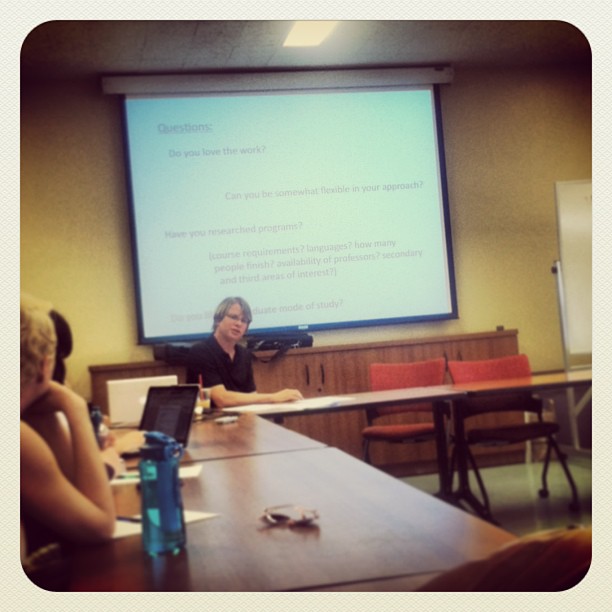
AGSE hosted Dr. Kent Baxter to share his journey in getting his PhD. This was a great opportunity to learn a little more about our Graduate Advisor as well as gain some valuable knowledge about the PhD process.

Couldn't make it on May 9th? Thanks to your 2013 - 2014 Recording Secretary, Wafa Azeem, here is a recap of the day's talk!  

Dr. Baxter’s story: 
He received his bachelor’s degree from CSUN in 1983, going from a music major, to Psychology, before finally choosing English. It took him 5 ½ years to get his degree.
He applied to UCLA, UCB, and USC for their PhD programs, getting accepted to USC, then deferring a year to travel in Europe instead.
When Dr. Baxter returned, he wasn't allowed to reclaim his spot at USC, but got incredibly lucky and found a place because someone else had dropped.
Through hard work and perseverance, he received his doctorate.


Some things to consider for a PhD:

  • Are you interested in independent and focused learning? Do you work well without a lot of “hand
    holding?”: You really, really, really have to love the work that you do and the subject that you’re working on. You’re going to face a lot of obstacles and your passion is what will get you through it. (The programs are also really competitive and this creates a lot of anxiety, so again, you really need to love the work.)
  • Think about funding: Teaching English Composition or a T.A.-ship can get tuition waived and sometimes may include a stipend.
  • If you’re willing to put in the hard work and effort the program requires, you will do quite well, regardless of background. 
  • You learn a lot through teaching, so consider the teaching opportunities the school has.
  • Academic relationships are essential, so look at how available the faculty is and how involved they are. 
  • Check the requirements of the school; do they require you to have fluency in two languages? 

Job Market:

5% RI- Research schools. (Usually the elite schools like Harvard and Yale).
95% in schools like CSUN (Where research emphasis is lighter than the RI schools. Focus more on teaching).

Questions to ask yourself:

Do you really love the work?
Do you like the graduate mode of study?
Can you be somewhat flexible in your approach to the program? (How broad is the program. Are you willing to explore different avenues of the topic?)
Have you researched programs?
Course requirements?
Languages?
How many people actually finish the program?
Availability of professors?


Thank you to everyone who could join us, and to the 2013 - 2014 board members: Wafa Azeem for her notes, and Stephanie Lim, for her pictures.

Wednesday, May 2, 2012

Highlights from “Path to the PhD” Workshop


Today Dr. Ranita Chatterjee graced our meeting with her wisdom and experience about her own, as well as the general, steps one takes to become a PhD. She outlined three main components that influence one’s academic career and those are: mentors, determination, and the overarching narrative of one’s goal.
Though most of us only know what is academically prudent to ask, Dr. Chatterjee shared her own personal journey to graduate study. Born into a family of academics, Dr. Chatterjee was first mentored by her parents who always encouraged her to seek higher education.


While Dr. Chatterjee attended the University of Calgary, she was convinced that she would pursue a career in the sciences and took everything from biology to zoology, but an illness forced her to leave the science labs that were aggravating her health. Turning to the humanities, Dr. Chatterjee chose to study English hoping eventually to become a scientific journalist.  Though english was not a subject she was exceedingly passionate about, Dr. Chatterjee fell in love with the subject when she discovered theory; its formulaic philosophy appealing to her scientific mind.


Graduating with a BA in English with a minor in Biology, Dr. Chatterjee applied to several MA programs in Canada, choosing to go east of her Calgary home to McMaster University near Toronto. At twenty-two years old, graduate school seemed daunting as Dr. Chatterjee was surrounded by more experienced scholars, yet she was determined to continue with her education.


Getting into a Master’s program proved fairly easy compared to the immense process of applying to doctoral programs of which none accepted Dr. Chatterjee. With few options, she chose to attend University of Waterloo to obtain an M Phil, which is a degree between an MA and a PhD. A year later she reapplied and was accepted into the University of Western Ontario in late July (a decision that came about because she was waitlisted).


From this long arduous journey to the highest level of graduate school and its completion years later, Dr. Chatterjee offers the following tips:  


Be Diplomatic


Though there may be some professors that do make your day, you should always maintain good standing with them. You never know who may be on the admission committee or friends with the right people.


Build a Relationship with Professors

Professors are a wealth of knowledge and the only way to get a good letter of recommendation, or ask someone to mentor you, is to first build that relationship with them. Visit during office hours and discuss something in their field. A good scholarly topic will always open up communication.


Choose a Mentor  

Mentors will the the key to academic success and guidance. Build that relationship and then listen to their advice. They are in the field you wish to study. Thus, they will know what schools would be best to apply to and which scholars might help you to get in. Mentors can also advise on which courses to take in order for you to have the best advantage. Mentors can also help by becoming advisors for scholarships such as the Pre-Doc that is due every year at CSUN in March.
When Applying to PhD Programs

1. Ask yourself why you are doing it, because a doctorate will not guarantee you a job.
2. Think of the complete package when applying to the PhD program:
a. GPA must be high, close to 4.0
b. break 700 in the GRE, aim for a high score in the subject area. The admission committee won’t look at it unless it comes down to two people and the score must break the tie
c. Writing sample- must match the statement of purpose area of interest.  If your sample is written about something different, you must explain why with a good reason
d. Statement of interest: What you want to do in your PhD, like a proposal for the dissertation, but you need a bridge for what you did in you MA and what you want to do in the PhD program. Must be short and be concise, clear, and superimpose a narrative of your choice to go into a doctorate program
e. Letters- You do not want form letters from professors. Some letters ask about your percentile rank and personality so you want a professor who really knows you and your work.

The Narrative: Make sure you mention your own experience in your application such as clubs in which you have served as an officer or any work experience. Always include this in your statement to show your life experience. 


How to Choose a School:


Pick a school that offers the three areas of interest you wish to study and explain in your statement how this will factor in, as well as the authors you want to examine.  


Rejections are a sign that you tried, so do not become discouraged.

Once in the Program
You will spend two years taking classes and most likely teaching.


Comprehensive exams: These are really in depth and cover everything from 1780-1920 time span. You get one year where you study then show up and take test for 4 hours written, then a 3-hour oral exam.

Some people who cannot manage time spend this year slacking off, panic and then fail. This is where determination and discipline play a role.


ABD LevelAll but dissertation level is where you have passed exams and then you must complete your dissertation. This is a lonely time where you research and write. At times critiques from your mentor may become daunting, but personal determination and a supportive mentor will help. 


The Job : You must be willing to move anywhere there is a job. Dr. Chatterjee’s own path brought her from Canada to Salt Lake City, Utah to Vassar College in New York and finally to us, in sunny California.

AGSE thanks Dr. Chatterjee for sharing her knowledge, advice and most of all, her story of struggle, disappointment, rejection and ultimate determination and success.


Friday, April 27, 2012

AGSE Presents its End of the Year Workshop

 “The Path to the PhD”


Wondering what to do after graduation? Thinking about graduate school? Then come to AGSE’s final workshop hosted by Dr. Ranita Chatterjee as she relates her own path from her BA at the University of Calgary to her MA at McMaster University and finally her PhD at the University of Western Ontario. Learn about the steps to graduate education and academic success!
 May 2, 2012
 JR319 
 2pm